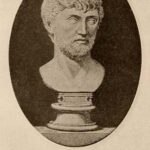
Lucius Annaeus Seneca (4 BCE – 65 ACE), also known as Seneca the Younger, was a Roman statesman, dramatist and Stoic philosopher. He was chiefly known as a philosopher who taught the Stoic art of self-restraint, mainly in order to help man better navigate and cope with the harsh conditions of a short life. He is also known for being an advisor to emperor Nero, which later had him killed through suicide.
Stoicism as a distinct school of philosophy is known to have been founded by Zeno of Citium (335-264 BCE). The term stoicism comes from the Greek “stoa poikile” which was the place or literally ‘porch’ in Athens where Zeno had most of his philosophical discourses with his disciples. The Stoics believed that man must resist and overcome the impulses, habits and fears which led people to vices, and in doing so, reaching a state of eudaimonia, blessed and tranquil state of mind.
The Life of Seneca
Born in 4 BCE in Corduba in the Roman province of Hispania Baetica (southern Spain), Seneca was the son of Helvia (mother) and his father Seneca the Elder (54 BCE – c. 39 ACE), who was a noted rhetorician and writer himself and authored the works “Controversiae” and who lived through the reigns of Augustus, Tiberius and Caligula. One of three brothers, Seneca (the Younger), moved with his family except for his mother Helvia, to Rome to get an proper education. In Rome Seneca was schooled in rhetorics and law but later came to be more interested in philosophy. It was during the reign of Tiberius, under the tutelage of the stoic Attalus, that Seneca learnt the basic tenets of Stoicism and of the ascetic lifestyle. In one of his letters, Seneca mentions his teacher Attalus with respect and praise:
And in truth, when he began to uphold poverty, and to show what a useless and dangerous burden was everything that passed the measure of our need, I often desired to leave his lecture-room a poor man. Whenever he castigated our pleasure-seeking lives, and extolled personal purity, moderation in diet, and a mind free from unnecessary, not to speak of unlawful, pleasures, the desire came upon me to limit my food and drink.
Seneca (Moral Letters to Lucilius – Letter 108)
Seneca is known for having suffered from poor health throughout his life, especially from asthma. His asthma attacks were severe and usually passed after one hour or so. Seneca mentioned his struggles with asthma and illnesses in another letter:
My ill-health had allowed me a long furlough, when suddenly it resumed the attack.
“What kind of ill-health?” you say.
And you surely have a right to ask; for it is true that no kind is unknown to me.
But I have been consigned, so to speak, to one special ailment. I do not know why I should call it by its Greek name; for it is well enough described as “shortness of breath.” Its attack is of very brief duration, like that of a squall at sea; it usually ends within an hour. Who indeed could breathe his last for long? I have passed through all the ills and dangers of the flesh; but nothing seems to me more troublesome than this. And naturally so; for anything else may be called illness; but this is a sort of continued “last gasp.”
Hence physicians call it “practising how to die.” For some day the breath will succeed in doing what it has so often essayed.
Seneca (Moral Letters to Lucilius – Letter 78)
Because of his health problems, at a young age, he sometimes contemplated suicide, but the thought of imposing this burden upon his father stopped him from doing so:
I often entertained the impulse of ending my life then and there; but the thought of my kind old father kept me back. For I reflected, not how bravely I had the power to die, but how little power he had to bear bravely the loss of me. And so I commanded myself to live. For sometimes it is an act of bravery even to live.
Seneca (Moral Letters to Lucilius – Letter 78)
Before he became a member of the Senate in Rome, he lived with his aunt in Egypt for a couple years, mainly due to health reasons. During this time he furthered his studies in various disciplines, not limiting himself only to the established Greek body of knowledge but the Egyptian as well.
His political life in Rome was tumultuous to say the least, as he came into conflict with three different emperors, Caligula, Claudius, the latter whose wife banished Seneca to the island of Corsica for 8 years on the charges of having an affair with Caligula’s sister Julia. After that, Seneca was invited back to Rome by Claudius’ new wife Julia Agrippina, who wanted the wise Seneca to become a teacher for her twelve-year-old son Lucius Domitrius Ahenobarbus, who later became Emperor Nero.
When Nero came to age and inherited the throne, Seneca became his imperial advisor alongside with the prefect of the Praetorian Guard, Sextus Afranius Burrus. During this time Seneca amassed a lot of wealth and properties.
Though Seneca tried to retire from his role as imperial advisor a couple years prior to his death, he was forced to keep his position. In the year 65, Seneca was accused of participating in a conspiracy, carried out by the Roman Senator Gaius Calpurnius Piso, for the purpose of overthrowing the emperor, and Seneca was ordered to kill himself.

The Death of Seneca by Manuel Domínguez Sánchez – 1871
Seneca’s stoicism placed reason and virtue first. Through reason one can keep the capricious emotions in order, a way to better cope with adversities and accidents that life will inevitably bring. In other words the equilibrium of mind was the goal of Seneca’s stoicism.
With that said, here is a collection of quotes and excerpts taken from the works of one of the greatest Stoic philosophers:
Number of quotes found: 95

It is not the man who has too little, but the man who craves more, that is poor.
Source: Letters from a Stoic - Letter II: On Discursiveness in Reading


It is a rough road that leads to the heights of greatness.
Source: Letters from a Stoic - Letter LXXXIV: On Gathering Ideas
Our fears are more numerous than our dangers, and we suffer more in our imagination than in reality.

Just as the mother’s womb holds us for ten months not in preparation for itself but for the region to which we seem to be discharged when we are capable of drawing breath and surviving in the open, so in the span extending from infancy to old age we are ripening for another birth. Another beginning awaits us, another status. We cannot yet bear heaven’s light except at intervals; look unfalteringly, then, to that decisive hour which is the body’s last but not the soul’s. All that lies about you look upon as the luggage in a posting station; you must push on. At your departure Nature strips you as bare as at your entry. You cannot carry out more than you brought in; indeed, you must lay down a good part of what you brought into life. The envelope of skin, which is your last covering, will be stripped off; the flesh and the blood which is diffused and courses through the whole of it will be stripped off; the bones and sinews which are the structural support of the shapeless and precarious mass will be stripped off. That day which you dread as the end is your birth into eternity.
Source: Letters from a Stoic
There are times when we ought to die and are unwilling; sometimes we die and are unwilling. No one is so ignorant as not to know that we must at some time die; nevertheless, when one draws near death, one turns to flight, trembles, and laments. Would you not think him an utter fool who wept because he was not alive a thousand years ago? And is he not just as much of a fool who weeps because he will not be alive a thousand years from now? It is all the same; you will not be, and you were not. Neither of these periods of time belongs to you. You have been cast upon this point of time; if you would make it longer, how much longer shall you make it? Why weep? Why pray? You are taking pains to no purpose.
Source: Letters from a Stoic

What is harder than rock? What is softer than water? Yet hard rocks are hollowed out by soft water.
Source: Natural Questions
Death is a release from and an end of all pains: beyond it our sufferings cannot extend: it restores us to the peaceful rest in which we lay before we were born. If anyone pities the dead, he ought also to pity those who have not been born. Death is neither a good nor a bad thing, for that alone which is something can be a good or a bad thing: but that which is nothing, and reduces all things to nothing, does not hand us over to either fortune, because good and bad require some material to work upon. Fortune cannot take ahold of that which Nature has let go, nor can a man be unhappy if he is nothing.
Source: Of Consolation - To Marcia
And, on the other hand, if death comes near with its summons, even though it be untimely in its arrival, though it cut one off in one’s prime, a man has had a taste of all that the longest life can give. Such a man has in great measure come to understand the universe. He knows that honourable things do not depend on time for their growth; but any life must seem short to those who measure its length by pleasures which are empty and for that reason unbounded.
Source: Letters from a Stoic
No man is ever made braver through anger, except the one who would never have been brave without anger. It comes, then, not as a help to virtue, but as a substitute for it. And is it not true that if anger were a good, it would come naturally to those who are the most perfect? But the fact is, children, old men, and the sick are most prone to anger, and weakness of any sort is by nature captious.
Source: Of Anger - Book I
Do not quarrel with your own good advantage, and, until you shall have made your way to the truth, keep alive this hope in your minds, be willing to receive the news of a better life, and encourage it by your admiration and your prayers; it is to the interest of the commonwealth of mankind that there should be someone who is unconquered, someone against whom fortune has no power.
Source: Letter to Serenus - On the Firmness of the Wise Man - Chapter XIX
We may choose to define it by calling that man happy who knows good and bad only in the form of good or bad minds: who worships honor, and is satisfied with his own virtue, who is neither puffed up by good fortune nor cast down by evil fortune, who knows no other good than that which he is able to bestow upon himself, whose real pleasure lies in despising pleasures.
Source: On the Happy Life