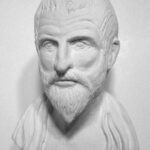
Neoplatonism
Derived from the thoughts of Plato, neoplatonism was a philosophical tradition that took its distinct form in Egypt through the thoughts of the 3rd century Alexandrian philosopher Ammonius Saccas, but reached its climax in the works of his student Plotinus, who was mostly active in Rome. The early neoplatonic philosophers were mostly engaged in speculative and metaphysically oriented philosophy, and they represented a kind of idealistic monism with an distinct emanation doctrine, in which everything in nature and the universe was to be regarded as outpourings or emanations of the highest reality, namely the One. This “One” was unreachable by the efforts of the intellectual mind, but could potentially be experienced by man’s innermost seat of perception.

Though Neoplatonism is widely recognized to be a philosophy, when one truly reads the works of Plotinus, the main figure in Neoplatonism of the classical world, one is struck by the mystical tendencies in his works.
One thing to know is that a mystic isn’t really a philosopher, though a mystic can begin with philosophy, poetry, art, prayer, ascetic practices, meditation or what have you, to attain to deeper insights into the nature of reality. What the mystic achieves is a perfect stillness or quietude of the sense of separate self/ego/psychological mind, and this was indeed something Plotinus often hinted at in the Enneads, which was recorded by his student Porphyry.
In my own understanding, the mystical experience that the neoplatonist philosophers, Plotinus in particular, pointed at was this: A perfect perpetual effortless contemplation on the One i.e. the Logos/God/Absolute, in which the “side-effects” consisted of an all-pervasive unfathomable silence.
Having said that, here are some of the most powerful spiritual quotes I came across when reading through the works and ideas of the neoplatonists.
/Daniel Seeker
Number of quotes found: 20
- one
- the one
- divine
- things
- soul
- gods
- intellectual
- place
- god
- existence
- body
- principle
- first
- time
- neither
- bodily
- perfect
- alone
- many
- intelligence
- therefore
- life
- produced
- beings
- far
- power
- come
- every
- established
- good
- proceeding
- prior
- reason
- order
- essence
- plotinus
- share
- principles
- let
- arguments
- eternity
- concerning
- plato
- shall
- appears
- find
- interpreters
- contains
- wisdom
- mind
- however
- whole
- world
- eternal
- whether
- ought
- noblest
- second
- intellect
- middle


God is not external to anyone, but is present with all things, though they are ignorant that he is so.
Source: The Enneads - 270
I am made by a God: from that God I came perfect above all forms of life, adequate to my function, self-sufficing, lacking nothing: for I am the container of all, that is, of every plant and every animal, of all the Kinds of created things, and many Gods and nations of Spirit-Beings and lofty souls and men happy in their goodness.
Source: The Enneads - 270


Let us, therefore, re-ascend to the good itself, which every soul desires; and in which it can alone find perfect repose.
Source: An Essay on the Beautiful
Soul is an essence without magnitude, immaterial, incorruptible, possessing its existence in life, and having life from itself.
Source: Auxiliaries to the Perception of Intelligible Natures

Hence there is a twofold death; the one, indeed, universally known, in which the body is liberated from the soul; but the other peculiar to philosophers, in which the soul is liberated from the body. Nor does the one entirely follow the other.
Source: Auxiliaries to the Perception of Intelligible Natures
Truly-existing being is neither great nor small, for magnitude and parvitude are properly the peculiarities of bulk. But true being transcends both magnitude and parvitude; and is above the greatest, and above the least; and is numerically one and the same, though it is found to be simultaneously participated by everything that is greatest, and everything that is least. You must not, therefore, conceive of it as something which is greatest; as you will then be dubious how, being that which is greatest, it is present with the smallest masses without being diminished or contracted. Nor must you conceive of...
Source: Auxiliaries to the Perception of Intelligible Natures

Before the things that really are, even the first principles of all things, is One Divine Being, prior even to the first God and King, abiding immovable in the aloneness of his own absolute unity. For neither is Intelligence nor any principle else intermingled with him, but he is established an exemplar of the God self-begotten, self-produced and only-begotten, the One truly Good. For he is the something Absolutely Great and Supreme, the Source of all things, and root of the first ideals subsisting in the Supreme Mind. Then from this One, the God sufficient in himself caused himself to shine forth: and hence he is self-engendered and self-sufficient. For he is the Beginning and God of Gods, a unity proceeding from the One, subsisting before essence, and the principle of essence. For from him are being and essence; and he is called accordingly Noëtarch, Chief of the realm of thought.
Source: On the Mysteries: De Mysteriis Aegyptiorum - The Two Souls of Man
Man has come into existence, a living being but not a member of the noblest order; he occupies by choice an intermediate rank; still, in that place in which he exists, Providence does not allow him to be reduced to nothing; on the contrary he is ever being led upwards by all those varied devices which the Divine employs in its labour to increase the dominance of moral value. The human race, therefore, is not deprived by Providence of its rational being; it retains its share, though necessarily limited, in wisdom, intelligence, executive power and right doing, the right doing, at least, of individuals to each other- and even in wronging others people think they are doing right and only paying what is due. Man is, therefore, a noble creation, as perfect as the scheme allows; a part, no doubt, in the fabric of the All, he yet holds a lot higher than that of all the other living things of earth.
Source: The Enneads - 270
In his twenty-eighth year he [Plotinus] felt the impulse to study philosophy and was recommended to the teachers in Alexandria who then had the highest reputation; but he came away from their lectures so depressed and full of sadness that he told his trouble to one of his friends. The friend, understanding the desire of his heart, sent him to Ammonius, whom he had not so far tried. He went and heard him, and said to his friend, “This is the man I was looking for.” From that day he stayed continually with Ammonius and acquired so complete a training in philosophy that he became eager to make acquaintance with the Persian philosophical discipline and that prevailing among the Indians.
Source: Life of Plotinus
For Plotinus, in his book On Numbers, enquiring whether beings subsist prior to numbers, or numbers prior to beings, clearly asserts that the first being subsists prior to numbers, and that it generates the divine number... But, after Plotinus, Porphyry in his treatise On Principles, evinces by many and beautiful arguments, that intellect is eternal, but that at the same time, it contains in itself something prior to the eternal, and through which it is conjoined with the one. For the one is above all eternity, but the eternal has a second, or rather third order in intellect. For it...
Source: Chapter XI, Platonic Theology - Book 1


But how shall we find the way? What method can we devise? How can one see the inconceivable Beauty which stays within in the holy sanctuary and does not come out where the profane may see It? Let him who can follow and come within, and leave outside the sight of his eyes and not turn back to the bodily splendours which he saw before. When he sees the beauty in bodies he must not run after them; we must know that they are images, traces, shadows, and hurry away to That which they image.”
That the One therefore is the principle of all things, and the first cause, and that all other things are posterior to the one, is I think evident from what has been said. I am astonished however at all the other interpreters of Plato, who admit the existence of the intellectual kingdom, but do not venerate the ineffable transcendency of the One, and its hyparxis which surpasses the whole of things.
Source: Chapter IV, Platonic Theology - Book 2
In the Intellectual Kosmos dwells Authentic Essence, with the Intellectual-Principle [Divine Mind] as the noblest of its content, but containing also souls, since every soul in this lower sphere has come thence: that is the world of unembodied spirits while to our world belong those that have entered body and undergone bodily division.
Source: The Enneads - Fourth Ennead